This seems right, not positive :/
A. Flowering plant – B
B. White flower Bin 2
B’. Purple flower Bin 3
A’. Non-Flowering plant – C
C. Cones Bin 1
C’. No cones Bin 4
This seems right, not positive :/
A. Flowering plant – B
B. White flower Bin 2
B’. Purple flower Bin 3
A’. Non-Flowering plant – C
C. Cones Bin 1
C’. No cones Bin 4
Dichotomous Key
A. Leaves needlelike, plant tree form, fruit is a cone (Bin 1)
A. Leaves flat, plant herbaceous and flowering
B. Leaves Simple (Bin 4)
B. Leaves Compound
C. Flowers contain six petals, violet (Bin 3)
C. Flowers contain four petals, white (Bin 2)
Good evening:
The dichotomous key I created to classify the species displayed in Bins 1-4 is embedded within this posting. Thanks!
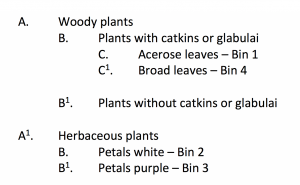
Here’s the second version with edits & corrections. – ELMV
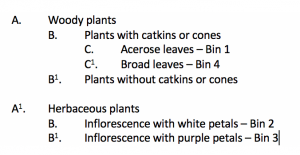
Hi everyone,
I spent the weekend out of range of wifi and cell service, but I’ve got the day off to catch up today. I am really enjoying learning a new vocabulary.
I used both the Cody and Hulten keys for keying out the violets. The second violet specimen was easy enough with the Cody key, but I had to use the Hulten to get the 1st. The Cody key used the roots, which weren’t present in the specimen. The Hulten key also referred more to descriptions of the flowers.
My conclusion is the 1st specimen is V. epipsila subsp. repens and the 2nd violet is V. renifolia var. brainerdii.
Then, for the spruce specimens, the 1st is P. glauca (white spruce) and the 2nd is P. mariana (black spruce, with hairy branchlets).
I tried to make my key in google docs, but the formatting with tabs & letters was working how I wanted it to. Trying to decide which characteristics to include was challenging. Here is what I came up with, which is very simplified. I feel like I should go into more detail about the flowers because they were so unique and different from each other. I think starting with larger categories makes the most sense, so I chose colors. (I know I am posting late, but I haven’t read the email conclusion of the assignment yet.)
A. Plants with needles
B. Branchlets glabrous………………………….Bin 1
B’. Branchlets pubescent
A’. Plants with leaves
C. Unisexual inflorescence (catkins)……..Bin 4
C’. Bisexual inflorescence
D. Purple flowers……………………..Bin 3
D’. White flowers………………………Bin 2
I was also confused by this assignment, but I believe the intention was to treat this like the lego exercise and devise our own dichotomous key from the bins provided. Here’s mine:
It seems I am not the only one struggling with this assignment. I understand the concept of dichotomous keys but I find it very difficult to decipher certain plant characteristics through a photograph. For instance, even on the exercise with the two different species of violets, I keyed out different species with the Hulten and Cody keys. I had no reference point for whether the rootstock of the violet was ‘slender’ or ‘stout’. I was also confused by the ‘bearded’ part. It seemed that the petals were slightly hairy and I would assume that would mean it had a ‘plant beard’ but apparently not. I found the Cody key much more straightforward than the Hulten.
Classmate, Rachel, and I decided to try and work on formulating the dichotomous keys together because we were both pretty confused. This is what I had in my notes and I’m about 90% positive I didn’t get the species correct. However, I will say that this exercise gave me a LOT better idea about what dichotomous keys are and that there are many different paths you can take when making your own. I could appreciate that Cody and Hulten took different perspectives in identifying the plants. I found that Cody’s was a bit simpler.
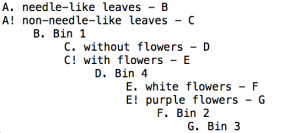
I chose to focus on just one feature present in the four bins. (Thank you, https://northernwoodlands.org/articles/article/needles-leaves). And that was plenty. It’s a bit of a logic puzzle. It took me a long time to think my way through labelling the choices A/A1—F in the second version I wrote. Still not sure if it flows; I think it does.
I have used dichotomous keys to identify mushrooms. They are definitely easier to use than create.
ps. 21 Types of Hairiness or Fuzziness, a fun list at https://www2.palomar.edu/users/warmstrong/termlf2.htm helped me with the word “lanate”.
Having very little experience with dichotomous keys and only a little experience with the proper names of plant pieces and parts, I struggled with this assignment and still am not sure what I’m doing. Though I’m familiar with some plant parts and use those for identification, the photos in the bins didn’t always have those parts. I was also confused by the sizes and other plants in the photos and even started keying out the compound leaves of the background plant in Bin 2 before I realized it wasn’t part of the specimen plant. This assignment took hours upon hours and included a 200 mile round-trip drive to get help from Rebecca, although much of the time I stared at the photos without a clue as to where to start. I’m still just stumbling around with the terminology – the struggle is real 😉 My first drafts of these dichotomous keys were using common words I could easily understand to describe the parts. Then I used the Harris & Harris book to find the correct (hopefully) terminology.
EDIT: After learning from Steffi that the assignment was to use the Bins to make a simple dichotomous key: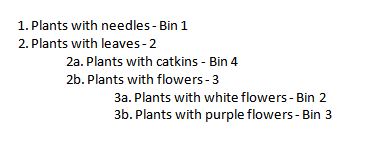
I struggled with this assignment too. I’m not sure how technical it is suppose to be and ended up spending a lot of time trying to find the scientific names of each one and this is what I have: