A: Are they short socks? – Type 1
A1: Are they long socks?
B: Are they multicolored?
C: Are they thin socks? – Type 2
C1: Are they thick socks? – Type 3
B1: Are they one color?
D: Are they thin socks? – Type 4
D1: Are they thick socks? – Type 5
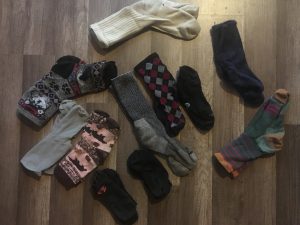
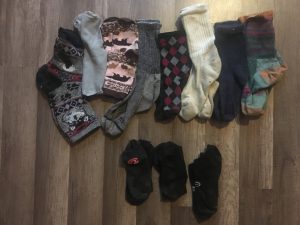
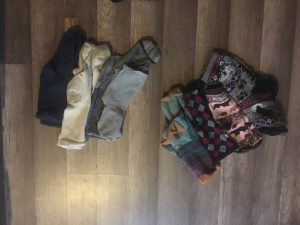
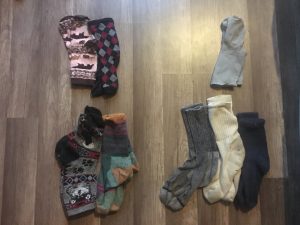
A: Are they short socks? – Type 1
A1: Are they long socks?
B: Are they multicolored?
C: Are they thin socks? – Type 2
C1: Are they thick socks? – Type 3
B1: Are they one color?
D: Are they thin socks? – Type 4
D1: Are they thick socks? – Type 5
A. Does the plant have flowers?
B: Is the flower purple? – Plant 3
B1: Is the flower white?- Plant 2
A1: Does the plant have needles?
C: Are they single needles? – Plant 1
C1: Are the bundled needles? – Plant 4
Dichotomous Key Exercise
Leaves elongated to form needles………………………………………………………………..……….PLANT 1
Leaves not elongated to form needles:
Flowers lacking petals………… …………………………………………….………………PLANT 4
Flowers with petals:
Flowers white in color………………….…………………………………………..PLANT 2
Flowers purple in color………………………………………………………..….PLANT 3
I way over-thought this process, as I initially thought we were to key-out the plants in each bin and develop a dichotomous key for each one. I’m so glad I reviewed the other posts and the instructions again, and hope that this is what we were asked to do:
A1. Is the plant woody? Bin 1
A2 Is the plant herbaceous? Go to B
B1 Does it have a single flower? Bin 3
B2 Does it show inflorescence? Go to C
C1 Does it have visible petals? Bin 2
C2 Does it not have visible petals? Bin 4
Dichotomous Key
At first this was a little confusing, I was thinking of the project in a really complicated way. I then realized it could be thought of in a simple manner as a process of elimination. A little thought in organization and classification was important but being really technical was not (in this case).
Revised Dichotomous Key
indentation was not retained when I pushed publish, for some reason.
A Needles , Bin 1
A1 Leaves, go to B
B Leaves with visible flowers, go to C
B1 Leaves with catkins/aments, Bin 4
C Flowers with white petals, Bin 2
C1 Flowers with blue/purple petals, Bin 3
Module 2
Dichotomous Key sample
Laura Emerson
For some reason, the post did not preserve the increasing indentation of each lettered section.
Bin 1:
A Tree with needles …go to B
A1 Tree without needles… go to x (not demonstrated)
B Tree with cones … go to C
B1 Tree without cones… go to x
C Tree with budding tips… go to D
C1 Tree without budding tips … (does that even exist? Or did I miss the point of the photo?)
D Tree with something distinctive about its bark (cannot tell what). … go to somewhere
D1 Tree lacking that something (go to x)
Bin 2:
A Flower with four petals … go to B
A1 Flower with other … goXXX
B Flower pendulous … go to C
B1 Flower upright … go xxx
C Flower white… go to D
C1 Flower color other …
D Leaf oval … go somewhere
D1 Leaf other shape… go xxx
E Trichomes on the stem… go to xxx
E1 No Trichomes on the stem… go toxxx
Bin 3:
A.Flower blue/purple… go to B
A1. Flower other color… go to xxx
B. Multiple stamens… go to C
B1. Few stamens… go to xxx
C. Multiple pistils… go to D
C1. Few pistils… go to xxx
B 4:
A Leaf elliptical (or is that lanceolate?) … go to B
A1 Leaf not that above… go elsewhere
B Leaf hairy… go to C
B1 Leaf not hairy … go elsewhere
C Multiple stamens, fused to ovary … go to D
C1 Few stamens … go to xxx
Thank you for clarifying Steffi! I definitely made that assignment harder than it was meant to be. I redid it and this is what I came up with. Dichotomous Key