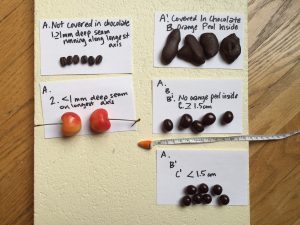
A- Plants with flowers ~> B
A’- Plants without flowers ~ plant 1
B- Flowers with petals ~> C
B’- Flowers without petals ~ plant 4
C- Petals are white ~ plant 2
C’- Petals are purple ~ plant 3
A- Plants with flowers ~> B
A’- Plants without flowers ~ plant 1
B- Flowers with petals ~> C
B’- Flowers without petals ~ plant 4
C- Petals are white ~ plant 2
C’- Petals are purple ~ plant 3
A Plants that do not have/produce flowers plant 1
A’ Plants that have/produce flowers
B Flowers that do have/ produce petals plant
B’ Flowers that do not have/produce petals plant
C Plants that have/produce Purple Petals plant 3
C’ Plants that have/produce white petals plant 2
D plants with visible pistils or stamens
D’ plants that lack visible reproductive organs
E plants that produce/have small flowers plant
E’ plants that produce/ have large flowers
Gymnosperm…………………………………..Plant 1
Angiosperm
Didn’t use a lot of technical terms, but this should still be useable.
A — Trees
>>>B – Tree with needles and cones
A1 — Not Trees
>>>B – Flowers with blue or white petals
>>>>>>C – Flowers with blue petals
>>>>>>C – Flowers with white petals
>>>B1 – Flowers with lots of pistils(?)
>>>>>>C – Pubescent leaves
OK. I am trying this with the four plant pictures now instead of the shoes. Let’s see if I am on the right track.
A. Plant is Woody Plant 1
A’ Plant is Herbaceous
…..B. Plant produces flowers
……….C. Plant with white petals Plant 2
………..C’ Plant with purple petals Plant 3
…..B’ Plant does not produce flowers Plant 4
A.Plant does not produce flowers….Plant 1
A’. Plant does produce flowers
B’. Plant produces flowers
C’. Plant does not produce purple flowers
D. Plant produces white flowers..Plant 2
Dichotomous Key to photos 1-4 Module 2
A. Plant lacking flowers, leaves needle-like, evergreen,
cones. ….. Plant 1
A’. Plant with flowers, leaves divided into peduncle and expanded blade, deciduous, lacking cones.
B. Flowers that lack petals, yellow. …Plant 4
B’. Flowers large with pedals, white or blue/violet
C. Four pedals per flowers, pedals white …. Plant 2
C’. More than four pedals per flower, pedals
blue/violet … Plant 3
A. Plant produces flowers
B. Single flower produced per stem . . . . . . . . . . . . . . . . . . . . . . . . . Plant 3
B1. Multiple flowers produced per stem
C. Flowers contain petals . . . . . . . . . . . . . . . . . . . . . . . . . . . Plant 2
C1. Flowers do not contain petals (only stamens) . . . . . . . . . Plant 4
A1. Plant does not produce flowers . . . . . . . . . . . . . . . . . . . . . . . . . . . . . . . Plant 1
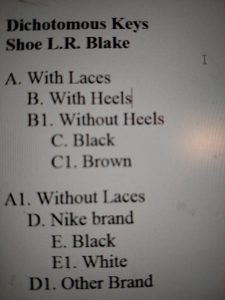
Hello, I felt the need to practice with my shoes prior to moving onto the plants. According to the History of Shoes-World Famous Inventors and Inventions, Lyman Reed Blake, an American inventor, invented a sewing machine to sew the modern soles of shoes. For purposes of my practice here, we shall give him credit for developing the American modern shoe sole. Let’s see if I have a decent understanding? Thanks for any input.
NOTE: the #1 after the letter signifies prime.