Good evening:
The dichotomous key I created to classify the species displayed in Bins 1-4 is embedded within this posting. Thanks!
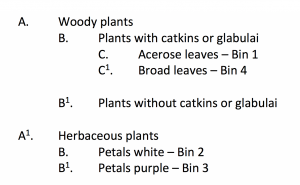
Here’s the second version with edits & corrections. – ELMV
Good evening:
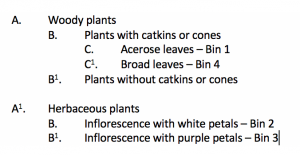
The dichotomous key I created to classify the species displayed in Bins 1-4 is embedded within this posting. Thanks!
Here’s the second version with edits & corrections. – ELMV

I think I’m finally getting it after looking at your example. I remember you and Lisa talking about “keying out” plants, but didn’t do any practicing during the field study, like I should have done. I really do love learning this science and how to speak the language. Thanks for helping to interpret dichotomous keys.

yes, i agree with Rachel! it’s nice to see examples. i went way too far w/mine! ha!

Yes,
this one works. Not sure what glabulai are?
I looked up botanical terms for cone and, now looking at it again, used an incorrect term and spelled it worng. I added an extra “a” in the plural form of glabulus (glablulus – singlar, glabuli – plural: a fleshy cone).
Hm, I can’t seem to add media to comments. I recreated the dichotomous key with the corrections and was going to insert it in here. Perhaps I’ll be able to add it to my original post.
Thanks, I got it! Thanks for your explanation. The revised key works well!

It was very helpful to look at your D. Keys! Thanks! Glad to see you are in this class!
Leave a Reply