Category: Miscellaneous

  • Accounting Artist

    Hello everyone!

    I hope you are all as excited for this class as I am. My name is Destiny and I am an accounting student at UAF in my final year of my degree. I was born and raised in Alaska. Outside of school and work, I love to paint and draw portraits. I also like to incorporate flora into my work. I enrolled in this course so that I could learn more about my art’s subject matter, and to gain a better understanding of flora overall. I am currently in Juneau (normally in Fairbanks) and the climate is very different here. I love all of the different types of flowers and trees and hope to learn more about them through this course as well.

    Here is what I have for my microscope.

    I look forward to learning alongside you all!

    Best,

    Destiny

  • Hola Amigos,

    Paolo, here attempting to introduce myself for my first eCampus class.

    I arrived in Juneau in 1972 and Fairbanks in 1975. I bought several acres of boreal forest & permafrost near Ester and have lived there off grid since. I also recently returned from my 24th trip to South America. I used to be an explorer in the Andes and Amazon but age caught up with me. I am still a researcher and occasional lecturer, having given 200+ talks on Machu Picchu (a well known Inca site), often to local guides in Spanish.

    Some things that sparked my interest in botany were ‘terra preta’ or biochar, which sustained Amazonian agriculture for millennia; yacón, an amazing tuber that can be grown in Fairbanks and contracting leishmaniasis four decades ago when I was effectively cured by a jungle ‘weed’. Dr. Meriam Karlsson at UAF has a few of the plants growing and I believe it might be a remedy for MRSA. Still, what I know about botany might just be visible under a macro lens. I watched all of Steffi’s videos in the first Module and, although she explained it clearly, I could barely decipher what was said. However, confusion may be a good place to begin learning something about Alaska flora.

    I have a decent camera but will probably use my iPad with a macro lens and MacBook’s microscope for this course, assuming I don’t expatriate, given my frustrations about a conundrum of indecipherable terms.

    Maybe I will even learn to forage without poisoning myself.

    Paolo

  • Hello From the Kenai Peninsula

    I’m a Social Work major in my senior year, and I had been dreading taking a biology lab until my advisor told me this one would satisfy the requirements. I love growing and nurturing plants of all kinds; they exude peace and calm, and there is nothing better than having my hands in the dirt fussing over them. I’m looking forward to this course and exploring the mysterious insides of growing green things. Upon graduation (next May), I hope to work in juvenile justice, and use some of the hard learned lessons gained from raising my own four children for the benefit of those who haven’t had positive parental examples. (Sorry the picture is sideways 🙂

  • Intro from Josh

    Hi everyone! I am an anthropologist with the U.S. Fish and Wildlife Service’s Office of Subsistence Management. I finished my PhD in ethnobiology at UAF in 2016 and my research focus was in ethnozoology, not the more common ethnobotany. Though I currently work as a social scientist, I also have a master’s degree in biology. Despite the degrees I never had the opportunity to take many botany classes. I have always enjoyed exploring the floral world, especially doing some hobby identification of wildflowers every spring and summer.

    I currently live in Eagle River with my husband Dustin, our two dogs, and our large flock of chickens. Dustin and I just got married last Saturday so things have been a little hectic recently. I am also starting a new job in two weeks as the Regional Subsistence Manager for the National Park Service. I’m excited to be a student again too and to learn more about Alaska’s flora alongside of other distance learners.

  • Hello everyone!

    I moved to Fairbanks this past October and I’m excited to learn more about botany in general and the flora of Alaska in particular! I work as a copywriter and copyeditor in industries that have nothing to do with botany, but I always love learning. A deeper knowledge of what I’m seeing makes it easier for me to appreciate the landscape when I’m adventuring outside.   I’ve also spent lots of time exploring northeastern Minnesota, which is on the southern edge of the boreal forest and has many of the same plant species. It’s been fun to notice the differences between a particular species growing both here and in Minnesota, and I look forward to learning a new vocabulary to describe these characteristics.

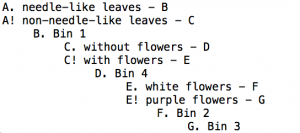
  • Dichotomous Key

    I way over-thought this process, as I initially thought we were to key-out the plants in each bin and develop a dichotomous key for each one. I’m so glad I reviewed the other posts and the instructions again, and hope that this is what we were asked to do:

    Dichotomous key

  • Rheum rhabarbarum dissection 4/4

    Rheum rhabarbarum POLYGONACEAE
    1. Habitat, growing at edge of our yard with grass, clover, wild geranium, spruce and birch.
    2. Leaves- simple, alternate


    3. Inflorescence is a panicle

    4. Flowers- ovary superior 3 fused carpels.


    5. Achene fruit.
    6. 6 petaloid tepals

    7. 6 connote petaloid tepals.
    8. Stamens, 6-9.

    9. Dehiscent fruits.
    10. 3 fused carpels.

    11. I cant tell the placentation, the seed fell out of the carpel so maybe it is free central placentation.
    12. 1 seed per carpel.

  • Rosa acicularis dissection 2/4

    Rosa acicularis, family ROSACEAE
    1. Habitat- well drained hillside with alder, birch, wild geranium, and high bush cranberries.
    2. Leaves, odd pinnate with simply serrate leaflets.
    3. Inflorescence- flowers solitary
    4. Flowers, perfect, actinomorphic, 5-merous.
    5. Fruits- none present.
    6. Five petals.
    7. Five sepals.
    8. Many stamen.
    9. Indehiscent fruits.
    10. One carpel.
    11. Placentation basal.
    12. Many seeds.

  • Dichotomous Key

    I was also confused by this assignment, but I believe the intention was to treat this like the lego exercise and devise our own dichotomous key from the bins provided. Here’s mine:

  • Plant Pressing Specimens


    I went flower hunting last night and I must have found at least 20 different varieties of flower /at least/ on UAF’s campus! What   an enlightening and fun experience. One of my favorite flowers is pictured, pressed. Lonicera tatarica, an invasive honeysuckle originally native to Siberia. I think it is a shrub with amazingly beautiful flowers. Also pictured are Vaccinium vitis-idaea a.k.a the low-bush cranberry a.k.a lingonberry flowers. The last specimen in this post is Campinula rotundifolia, Bluebells of Scotland. (At least, I hope they are the correct species I have described them as, there seem to be many bluebell/harebell varieties, but the “Scotland” variety was the one that appeared most often in the searches for blue flowers of Interior Alaska.)