Category: Miscellaneous

  • The Weeping Willow in Disney’s Pocahontas

    A great example of a plant in film would be Grandmother Willow from Disney’s Pocahontas. The weeping willow, Salix babylonica, has a narrative character that symbolizes ancestral wisdom and serves as a guiding voice for Pocahontas. In my opinion, having a character with such a wise and experienced persona being represented by a weeping willow is extremely fitting, as the long weaving branches and leaves can show just how long that tree has been around. Using the bark surrounding her face to represent wrinkles was a nice touch, too. Throughout the movie, we see Pocahontas consistently visit Grandmother Willow for advice and insight on how to handle John Smith and the rest of the newcomers who want to invade her lands. The willow’s sage mind rooted in love and peace helped Pocahontas follow her heart and stop the hate between her people and newcomers, resulting in John Smith’s life being spared in addition to being able to openly embrace the love both he and Pocahontas shared.

    Listening to our elders’ and ancestors’ stories and experiences can guide us to an easier path in life. As a child watching this film, Grandmother Willow always left an impression on me. Therefore, being the child of two immigrants, whose grandmothers were oceans away, I always found comfort in the willow tree’s character along with willow trees in general. There is something so poetic and calming about the gentleness in the swaying of their long, wispy branches and leaves. The catkins produced in the spring that later turn cottony add an ethereal charm which sadly the movie did not capture. Overall, the stories that could be told by the droopy weeping willows were beautifully captured in Disney’s rendition of Pocahontas.

    Goldberg, E., & Gabriel, M. (Directors). (1995). Pocahontas [Film]. Walt Disney Pictures.
  • Plants in Culture

    Marigold’s in the movie Coco

    In Pixar’s animated film Coco (2017), the marigold flower, known in Spanish as cempasúchil, plays an important symbolic and visual role. Traditionally used during Día de los Muertos (Day of the Dead) celebrations in Mexico, marigolds are believed to guide the spirits of the dead back to the land of the living. In the film, the petals form a glowing, magical bridge between the two worlds which allows Miguel, the main character, to enter the Land of the Dead.

    The marigolds in Coco represent memory, family, and tradition. Their bright orange color stands out in nearly every scene connected to the spirit world, creating a sense of warmth and reverence. They seem to bring out so much happiness despite what could be a sad atmosphere of sorrow.  The flowers also serve as a visual reminder that remembering loved ones keeps them alive in spirit. This is especially clear when Miguel places his great-great-grandfather’s photo on the ofrenda (altar), allowing him to cross over for Día de los Muertos.

    One of the most emotional moments in the film happens when Miguel sings “Remember Me” to his great-grandmother Coco, helping her recall her father. The marigold petals scattered around them seem to glow more brightly, reinforcing how memory and love connect generations. Rather than being just a magical element, the marigold reflects real cultural practices and adds depth to the story’s themes.

    By weaving the marigold flower into both the plot and visuals, Coco highlights the importance of honoring family and cultural heritage. It’s a beautiful example of how a plant can carry emotional weight and meaning in storytelling.

    Reference:

    Unkrich, L., & Molina, A. (Directors). (2017). Coco [Film]. Pixar Animation Studios; Walt Disney Pictures. 

  • Anyone want to join Alaska Science Teachers Association?

    We have a website that we struggle to keep updated because our membership has dwindled through pandemic and general teacher overload. http://aksta.org

    Every one of you who chose to learn more about our “backyards” over the summer models the kind of motivation ASTA would love to support. Check out the website and consider whether you could be part of a network of teachers who encourages each other despite or because of the challenges we face in fitting in GOOD science education K-12.

    Thanks for considering it!

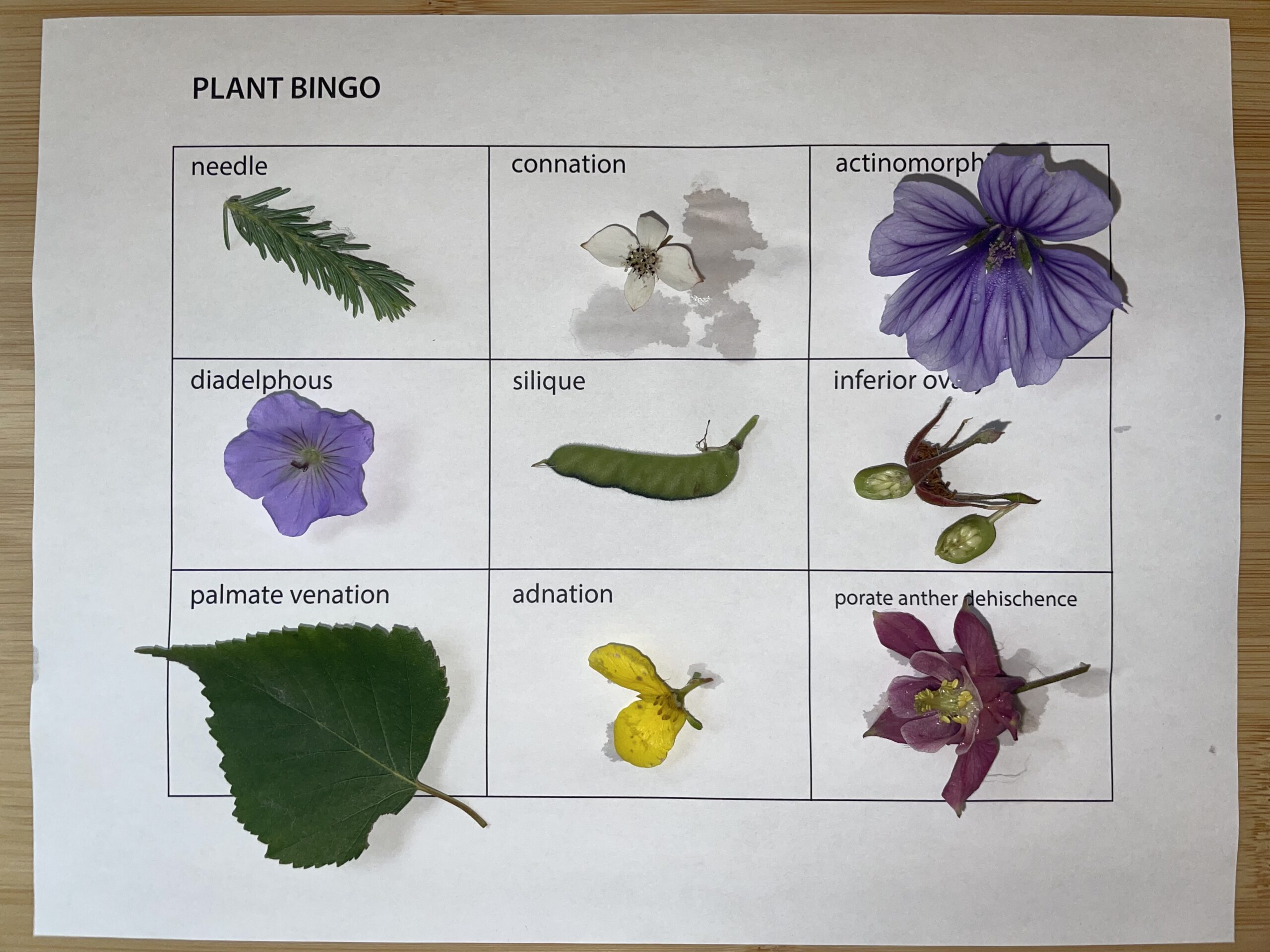
  • Bingo- Amanda Kemp

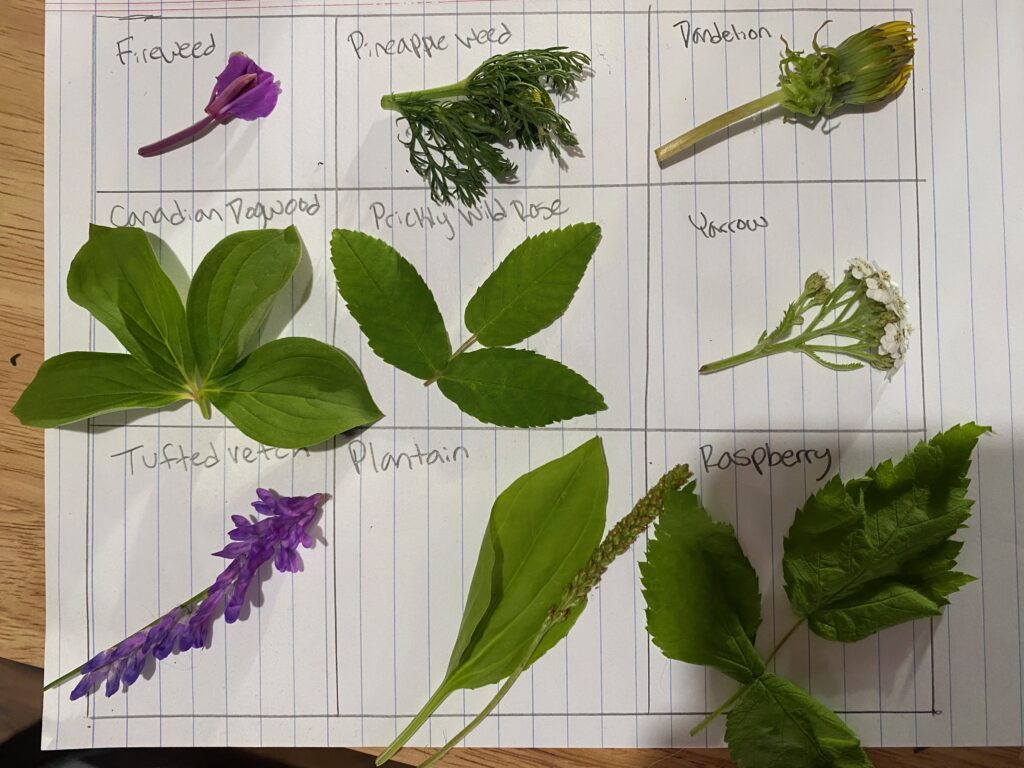
    This was difficult but really fun!

  • Plant Bingo
  • misc bears

    If you have time for a study break, may I suggest to biology fans this link that is ever popular right now, and comes from the Katmai National Park, King Salmon, AK, on an online platform similar to iNaturalist, but videos, with chats: https://explore.org/livecams/brown-bears

  • Welcome to BIOL190 – Introduction to Flora of Alaska (Summer 2026)

    https://media.uaf.edu/media/t/0_urjbf5kw

    Welcome to class! Finally the day has come that we are unveiling the online version of BIOL190 – Introduction to Alaska’s Flora (in its 8th year).   Sorry the video is using the old class name, but you are in the right class BIOL190. I hope you are as excited as I am to learn about our incredible flora, get to know some of its players by name, and get close and personal with them through plant dissection.   The class will throw a lot of new terms at you, do not despair if that is a little overwhelming at first.   Look at it like learning a new language, you want to talk with your foreign friend and have a good conversation, but first you need to get all the vocabulary down. The first conversation might not be as refined as you may wish, but it will all fall into place once you have many small conversation with your friend(s) and classmates, and soon the concept of botanical terms will become second nature. Soon you will sit at the kitchen table and contemplate using canned or fresh berries for your tomato sauce :).   Have fun, and I am looking forward to learning more about the plants that grow in your area, and your adventures exploring your outdoor botanical laboratory.

    As some of you night have noticed, you will see posts from previous students on the WordPress site. That was done by design. You might even be interested in browsing through previous posts.   Lots of good stuff there from students that took the class in previous years.   Please do not plagiarize their work though :).

    Cheers, Steffi.

  • Plant Voucher Specimens: bladder-campion, devilsclub, cowparsnip, yellow avens

    Hello Everyone,

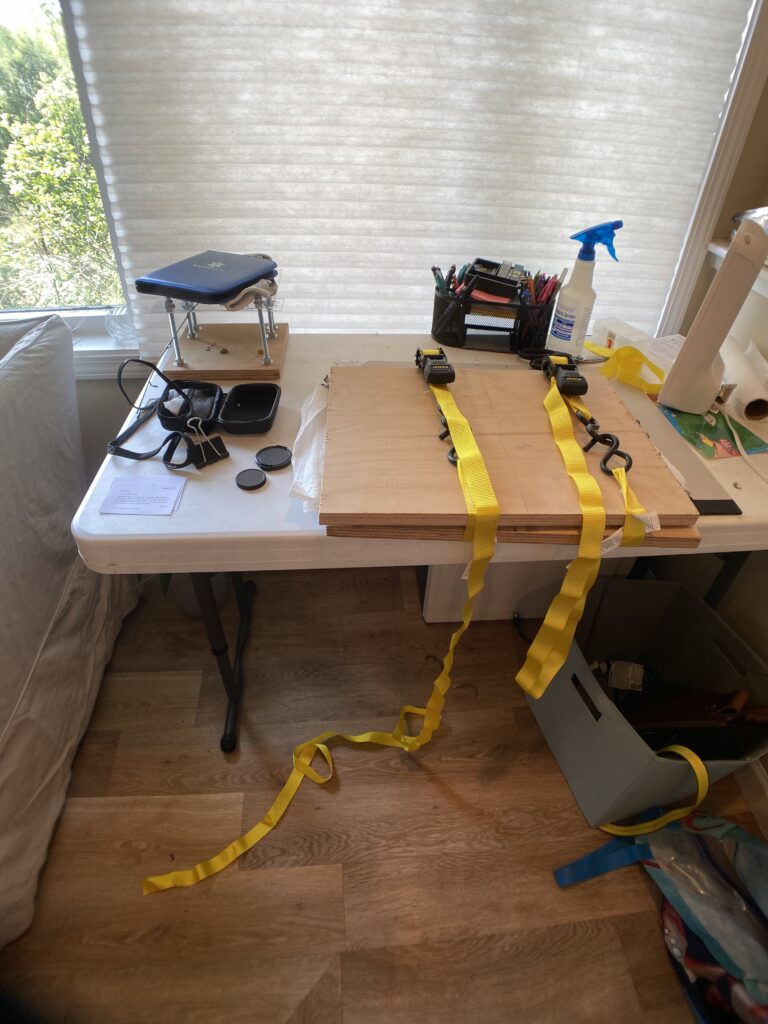
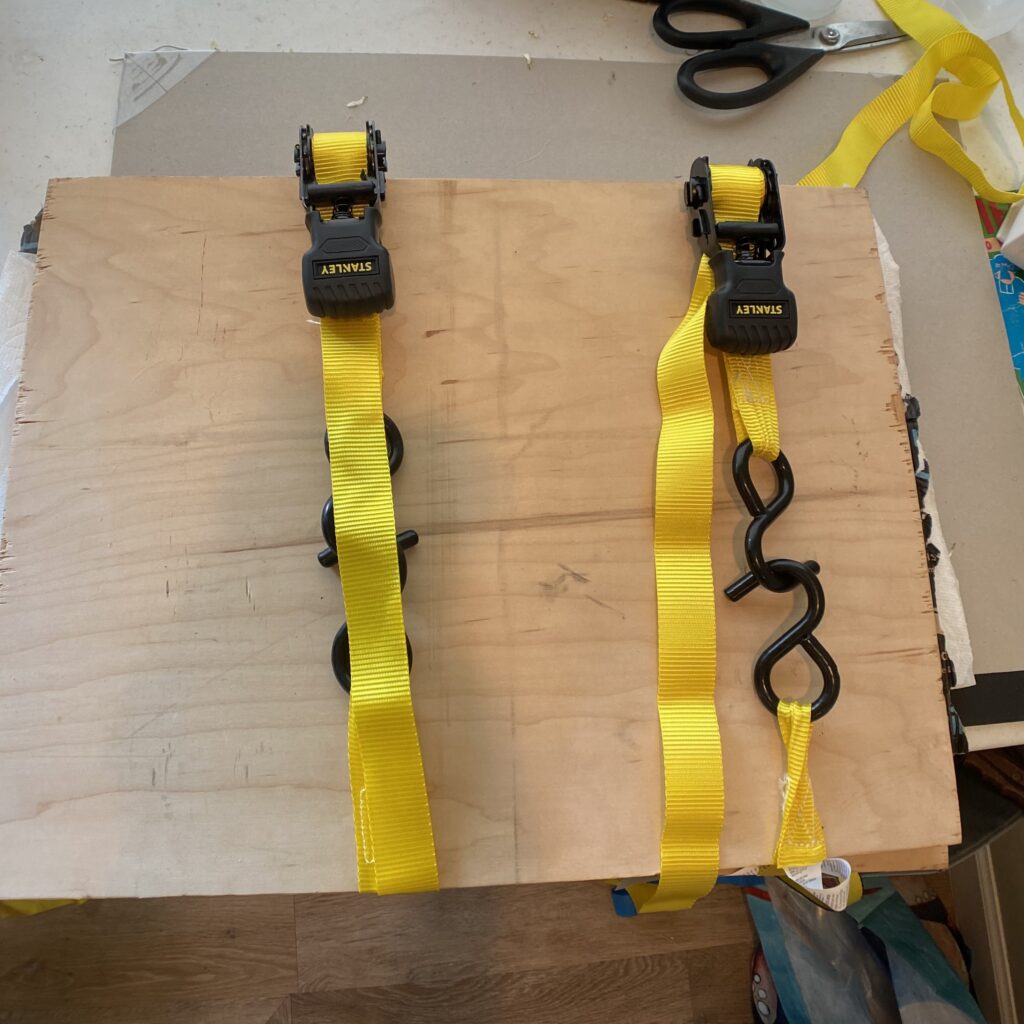
    I really enjoyed collecting and pressing “plant voucher specimens” for this class. This is my first attempt at pressing ever, and I did have some complications during my first run. For the press I used 2 boards of plywood and 2 tow straps (2 tow straps were sadly lost in the creation of this plant press). To layer between plants I used haphazardly cut pieces of cardboard boxes, paper towels, and newspaper.


    The “double stanley” bored method

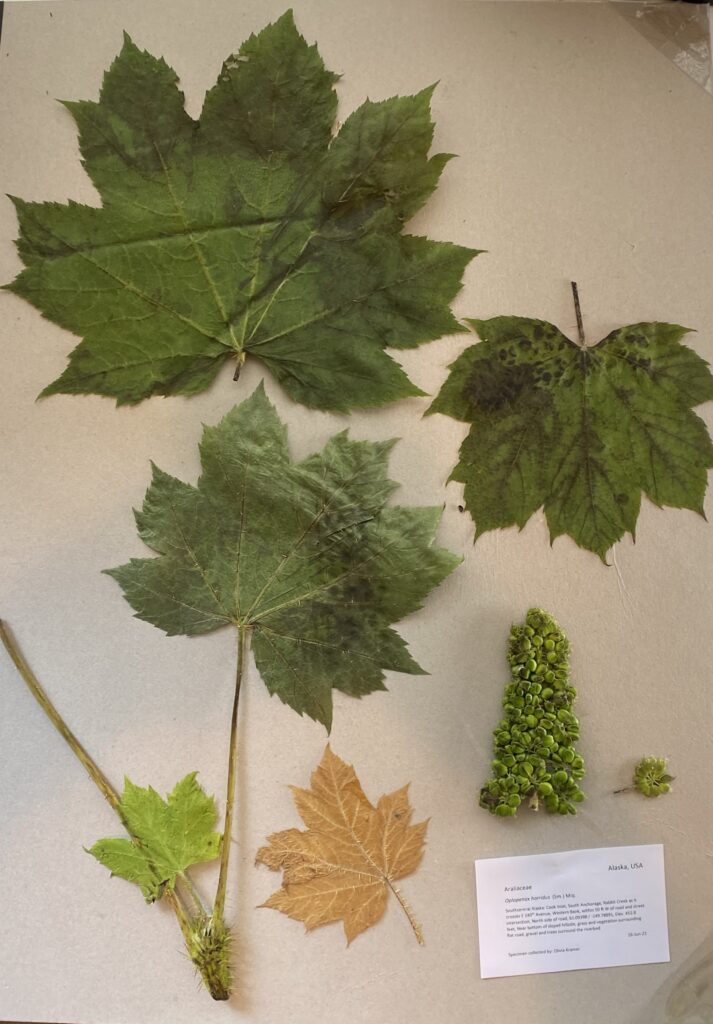
    Any imprint on the cardboard was reflected on the leaves – making it difficult to view the venation in the pressed subjects. In the future, I will apply more layers in between the newspaper plants. Paper towels, while textured, left no print and seem to be mostly reusable after drying. Wet fruits from the devils club were pressed too closely to a leaf and left a splotchy pattern- likely due to water retention. Coupling the use of more paper towels with the long-term possibility of creating a structure with more ventilation.

    I forget how to strap these every-time

    First Specimen is the prickly devilsclub…

    Araliaceae
    Oplopanax horriduc (Sm.) Miq.

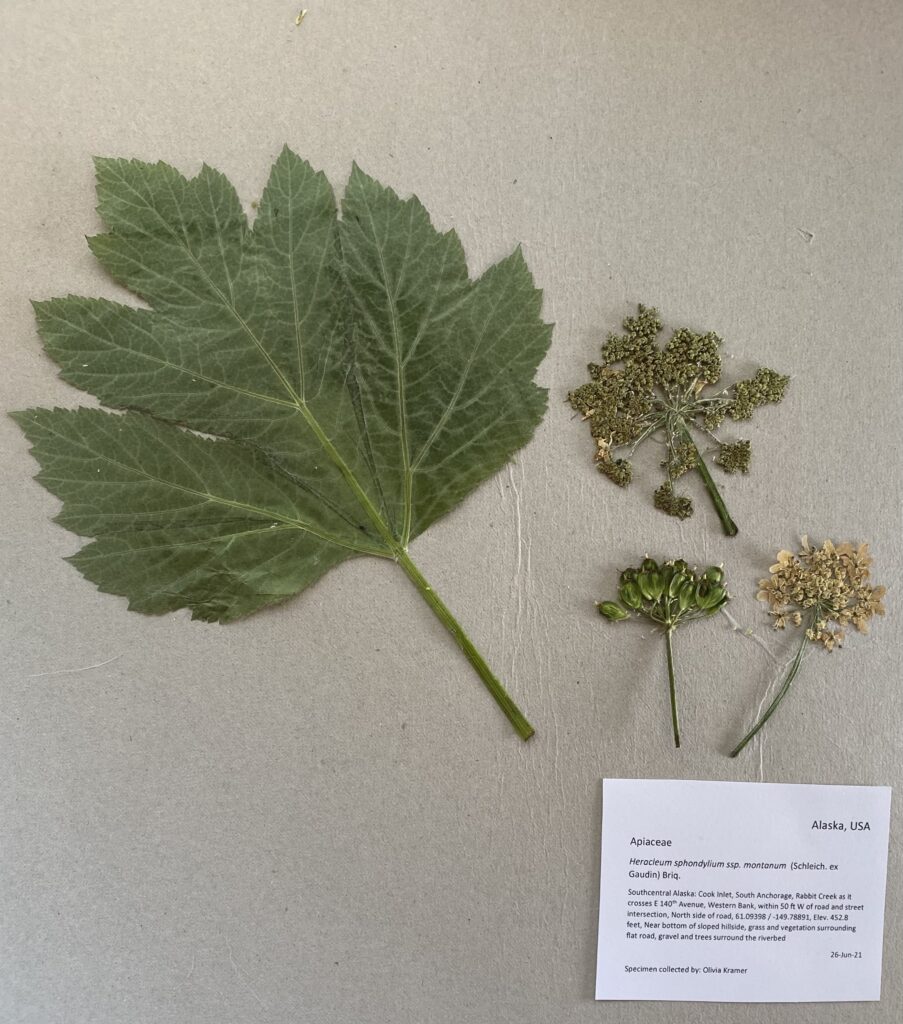
    Next up, the itchy cowparsnip…

    Apiaceae
    Heracleum sphondylium ssp. montanum (Schleich. ex Gaudin) Briq.

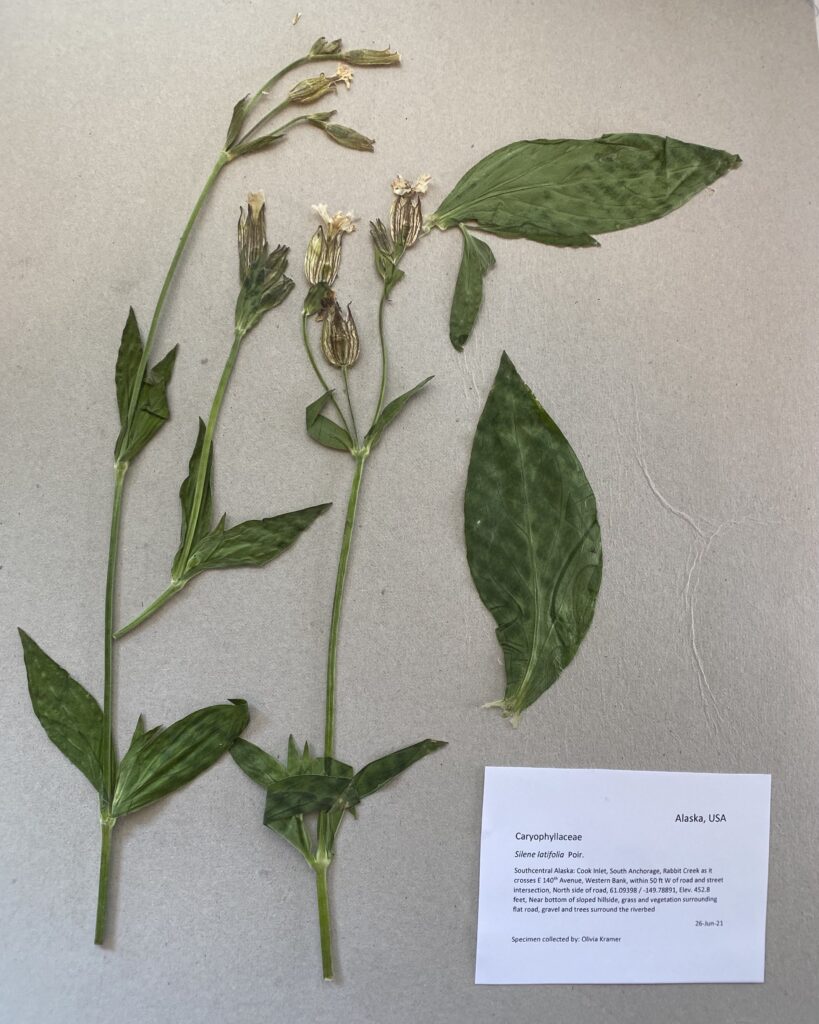
    I first identified the pretty bladder-campion for this class. As I have grown to enjoy it, I have also begun to notice it everywhere. Would be really cool to dissect because of the cool inflated calyx.

    Caryophyllaceae
    Silene latifolia Poir.

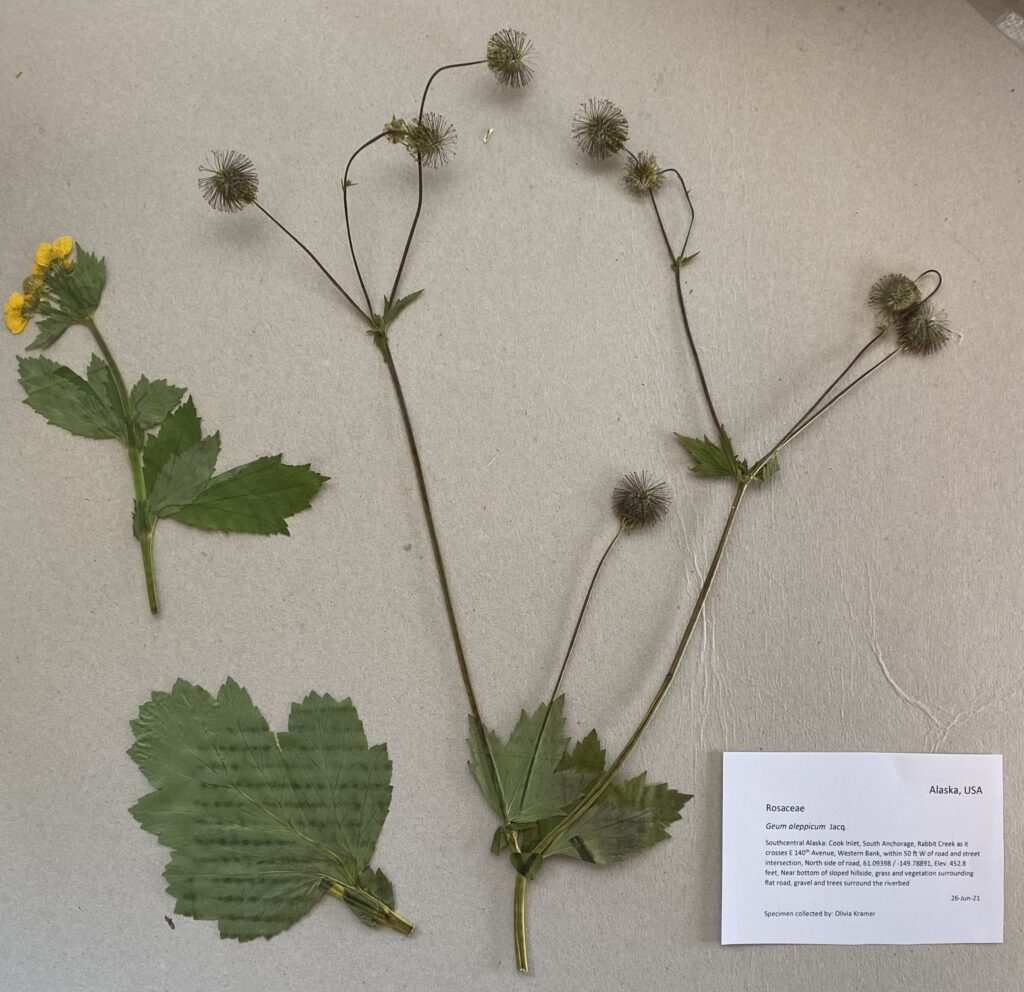
    Last Voucher I collected is the yellow avens. I see these spikey fruits(?) on my dog a lot. They resisted the press to the best of their abilities! Very strong and pokey.

    Rosaceae
    Geum aleppicum Jacq.