Category: Introductions

  • Erica McCall Valentine Introduction

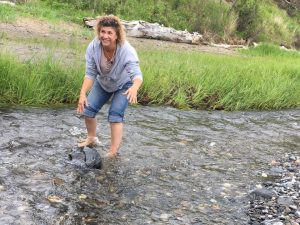
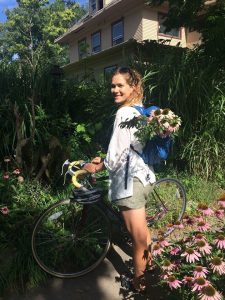
    Hello, my name is Erica McCall Valentine.  My apologies for starting this class a wee-bit late.  I wear a number of “hats” and over the course of much of last week I was attending to a doula client.  Yes, you read that right, I said “much of last week”.  The woman I was assisting was active labor for three days so I was focused on her instead of this class.  Supporting women in pregancy, labor and delivery, and breastfeeding isn’t my full-time job.  I’m also a social scientist focused on contemporary uses of subsistence (wild) foods and a (sometimes) adjuct instructor for the UAF ethnobotany (EBOT) program.  My interest in plants began when I first moved to Alaska at the age of 14.  That first summer up here I recieved Verna Pratt’s “Alaska Wildflowers” guidebook as a birthday present.  I spent a lot of time in the woods around our new house in Palmer, Alaska, and this book was my constant companion.  Over the years, my interest in plants continued to grow.  Not only do we – my family – harvest and use wild plants, my work also touches on human use of plants as food and medicine.  Currently, my husband and I live in Fairbanks, Alaska, with our two kids who are 13 and 10. Over the years, we’ve lived in a number of communities throughout Alaska – Palmer, Fairbanks (twice), Kodiak (twice), Cordova, Girdwood, and Talkeetna (my husband’s hometown- Hi Jayme!!).  I’m taking this class because I want to know more about the plants that the people I work with use, and as an adjunct instructor for the EBOT program I want to know what the EBOT students are learning as well.  Thanks for the opportunity to introduce myself.  I look forward to learning more about and from each of you as this class continues.
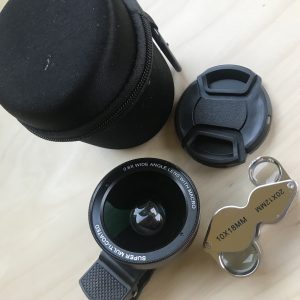
     

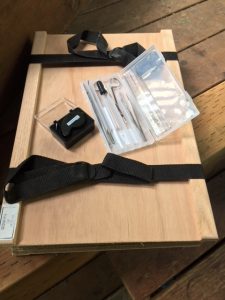
    My macrolens set up and loupe to aid in closer plant inspections
  • Introduction

    Hello from the Kenai. My name is Melissa Tuttle, I am 52 years old and just a few credits away from my BS in Environment and Society.   I am lucky enough to live on the banks of   Bishop Creek deep in the woods of Nikiski.   I have always enjoyed knowing what plant it is that I am looking at, I have a stack of beat up books that join me on my hikes who are kind enough to let me know what kind of   mushroom. or flower or tree I am looking at. I am excited to be taking this class an hope to increase my knowledge of the plants around me.   Amazon has already sent me my micro lens and I am waiting on the Opti-lens for a microscope option.

  • Equipment – Nikon camera

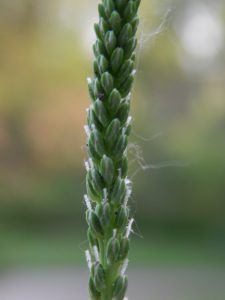
    I forgot to post in my introduction what equipment I’ll be using for this class. I’m old-school and have had a smart phone for only a few months and hardly ever take photos with it. I purchased the macro lens and have tried using it with my phone, but find it awkward and I get motion sickness using it. So, I’ve decided to use my Nikon L280 camera for the photos. I’ve been taking photos with a Nikon camera since 1980 and it just feels more comfortable. Plus, the close-up magnification seems to be just as good as the macro lens, as long as I have enough light to give me a fast shutter speed and no wind (as I discovered when trying to get a photo of plantain seeds.)

    I purchased the magnifying glasses for working with specimens. They seem to work good and even fit over my glasses. I like the hands-free capability they give me.

  • Hi from Anchorage

    Hello class,

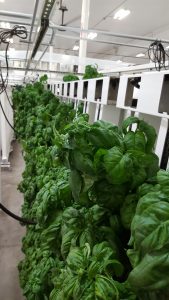
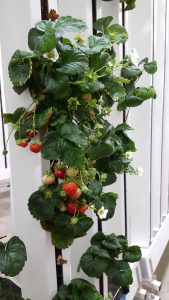
    About a year ago, I moved to Anchorage after spending over a decade in Fairbanks. I moved when I took the job of operations manager at Alaska Seeds of Change, a program of the a large local nonprofit, the Anchorage Community Mental Health Services. We operate an 8,000 hydroponic grow space that produces leafy greens, herbs, and strawberries all year round. It’s been in operation for about a year and a half, so we are still learning a ton. We employ between 10 and 15 “transition-age youth”, which, in the social work world, are young folks between the ages of 16 and 24 years old. It’s as much a supportive employment program as a food production program. I’ve included a couple pictures below. Some members of my staff are deeply interested in plants and very excited by the clip-on macro lens for smart phones that I’ll share with them. We are constantly examining problem plants for pests and other observations.

    We are starting a partnership with an Anchorage mushroom grower, so that’s recently opened my eyes to the world of mycelium as well.

    My undergraduate degree from back in Iowa, where I grew up, is in French and Linguistics. I worked at the UA Museum of the North when I first moved to Fairbanks and then later for a local tour company (ending up in the accounting department after a few years). Since I was a very small child, I’ve always been interested in plants. Some of my earliest and fondest memories are going for nature walks through the woods around my parents’ house in Iowa. Wildflowers were my first love.

    I’m taking this class because I am one class into the Ethnobotany Certificate program at UAF, and the last biology class I took was in high school. I am looking learning a new vocabulary as well.


  • Hi everyone

    Hi everyone.   I’m Damian.   I work full time in Anchorage, trying to set myself up for a permanent federal position but I need more Botany credits.   I also want to learn about the edible plants in the area in case of the zombie apocalypse!

  • Self Introduction

    Hello, Barbara Martin here in Tanana (34years?), sort of getting the hang of BlackBoard…
    another beautiful day in paradise, Spring is BURSTING, I have shared what I call the “Bloom Report” with anyone I can find who might be interested.
    The Calypso Orchids are blooming on top of Mission Hill now, also a quite worrisome spread of Death Camas.
    I am both excited and anxious about this Class.

  • Hello

    Hi, I’m Alissa. I live in Bountiful, Utah and am currently a student at Weber State University. I am doing a double major in  Botany and Anthropology and am the Botany Club President. I should be graduating in Spring 2019 as long as I can pass my nemesis Chemistry and O-Chem. Once I graduate I am planning on going on to Graduate school. I really am interested in Paleo-Botany or Ethnobotany. I also am the assistant lab and greenhouse manager  for the botany department. So,I have access to some great equipment. However, I did buy the lens for my phone and love it. I showed it to our taxonomy professor and he had me suggest it to his class. I have taken many botany classes here at Weber, but I love learning new things all the time. I’m very excited to see what is beyond my borders. My husband lived in Alaska for a few years and is always telling me how beautiful Fairbanks is, I always imagined snow & conifers. My pictures are from our greenhouse on campus
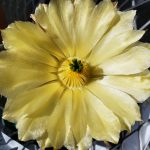
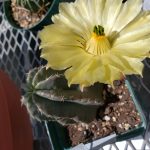
    Echinocereus subinermis
    Echinocereus subinermis
  • Hello from Talkeetna!

    Ready to ID & press!


    Greetings!

    My name is Jayme & I am from Talkeetna, yes, born & raised. I have been lucky to live in an area with wonderful plant & animal diversity &  having a home  near the Big-Su river, there  were over grown sloughs & ponds to play in that were full of aquatic plants & one of my favorite things…frogs! I was also extremely lucky  in that both my Grandmothers, from vastly  different lower 48 regions (rural Minnesota & rural Arkansas),  were plant lovers & taught  me as much as they could about gardening, AK native plants, perennials, composting & how to harvest & prepare. I became a Naturalist at a young age without even knowing  it was a thing!

    I wanted to become a Horticulturist, but there was no major in the UA system, so I decided to major in Natural Resource Management taking the plant, animal, soil science option so I could take all the plant classes. After thoroughly enjoying  every plant class I was able to get to & even creating my own interdisciplinary courses in Ethnobotany, I realized I had run out of options & decided to change majors because I simply did not want to be manage resources. I chose Human Services & after getting my Associate’s degree I then went into Social Work. For seven years I was able to  find an  equilibrium between  my course work in winter months & botany field work in summer months & have been able to work for BLM, CEMML, the USSWCD & Alaska Botanical Garden.

    Currently I am trying to finish up my BSW & have only a hand full of general requirements to get through, one just happened to be a 1 credit lab. When I found out that UAF  was offering Bio 195 online, I was thrilled! Systematic Botany was the only class I regret not being able to take, so being able to learn more about this makes me so happy. In addition, I now know that there is the EBOT option  at UAF  & since I  have so many plant classes under my belt, I hope to graduate  with a minor in Ethnobotany,  instead of NRM, which couldn’t be more appropriate for me.

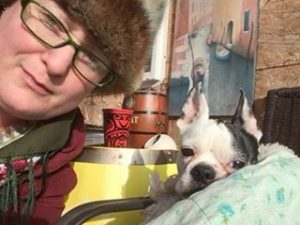
    I look forward to sharing my hometown landscapes & flora with you all & can’t wait to learn about the plants you share from the regions where you are at. My little Boston bull terrier, Myrtsy, will be my enthusiastic partner in crime & probably show up in  landscape photos from time to time!  Here’s to having a wonderful summer!


  • Intro

    Hello everyone! I’m Stefanie. I live in Anchorage, working and attending school full time going for my degree in biology. Currently I am a graphic designer but would like to work full time with wildlife in the future. I am very excited to take this class because I would like to be better able to identify plants around me when I am hiking, and also to know what I can do with them. I like to cook and bake so I am hoping to learn some new things about harvesting. I like to garden and am just generally interested in plants so I am looking forward to the class.

  • Rebecca’s Introduction

    Hello! My name is Rebecca and I’m currently finishing up my EBOT certification that I began in January of last year. I currently live in Lincoln, Nebraska and I was able to go to Hooper Bay, AK for the EBOT field course last summer. It was my first time visiting Alaska and it was so wonderful to be able to meet the plants that I had been studying from a distance. I’m pleased that this program has enabled me to learn so much about the plants around me here in Nebraska as well as Alaska. Through this program, I’ve been able to learn so much about plant uses, identification, chemistry and also it has also led me to meet many of the “plant nerds’ around me. I am really looking forward to photographing and dissecting plants in this class so I can better understand the anatomy plants.  

    Job-wise, I am working as a Garden Educator for a non-profit organization called Community Crops that manages community garden spaces in Lincoln. A large percentage of our gardeners are immigrants and refugees. I’ve found that these community gardens are a wonderful place to learn about ethnobotany. I am always learning new things from other gardeners while I’m out in the garden. I also help create content for the Save Our Monarchs Foundation. I love learning about plants and being able to share that information with others. I am looking forward to getting to know you all a little better and learning from you all.