Category: Dissections

  • Aquilegia Dissection

    I think columbine flowers are gorgeous and the leaves are pretty, too.

    The flowers have five petals and five sepals in decorator color contrasts.   The sepals are ovate and the petals are fused into conical shapes.   The plants have three lobed leaves,   grouped in threes themselves.    They favor dappled shade habitats. The stamens and pistils shoot far out beyond the petals, with the numerous stamens grouped like a bouquet around five (?)   pistils.   In some samples, the pistils were clearly taller (see straight stalks in fuzzy photo), but in others I could not see them within the crowd of stamens.The anthers look like they have vertical dehiscence, but that could be the natural division between the two compartments.   I could not tell anything about the interior of the ovary, but I think I sort of smashed it!   Seeds are encased in a skinny follicle that ejects the flat, shiny black seeds when it splits open along one suture.

  • Dissections (1 of 4)

    Labrador Tea

    Family: Ericaceae

    Habitat:

    Leaves:

    Inflorescence:

    Flowers: (one of 32) (also note the superior ovary)

    Petals: (5 per individual flower)

    Stamens: (7 per flower, total of 224 on flower bunch collected)

    Pistal:

  • Topaeolum Dissection

    Nasturtium is my favorite cultivated flower.   Easy going, tasty, beautiful, and fast growing. I use the leaves in sandwiches and pesto.

    The leaves are entire, peltate, smooth with L-O-N-G petioles that attach to the middle of each leaf.   The petioles and stems are almost juicy/succulent.

    The showy, single flowers have five petals, 3 of which are hairy at the bottom (called clawed) and two of which are not.   The literature describes 5 sepals, one of which is altered to become a spur which contains the reproductive parts, but in my samples, I found 5 sepals PLUS the spur.   The ovary is superior and small, with 8 stamens that look different in size and shape at this stage of development, see photo.Looks like vertical dehiscence. The one style is small. See it as the whiter element to the left side of the leaf, attached to one of the stamens.    When I cut into the ovary, I could not see anything useful (at 3:00 and 5:00 on the leaf), but it is reported to have 3 carpels.   The seed looks like a wrinkled little walnut that breaks easily into three parts, so 3 carpels make sense.


  • ELMValentine – Twinflower Dissection

    My second dissection was of a twinflower (Linnea borealis  L.).  I hesitated in picking this species to dissect because it’s so small and delicate, but I was pleasantly surprised  at the relative ease in dissecting it and zooming in on the small features.


  • Arnica angustifolia dissection

    Arnica angustifolia Vahl.

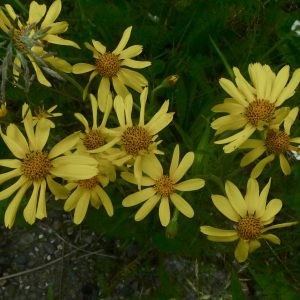
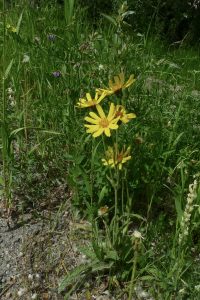
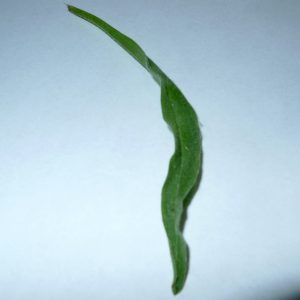
    Arnica angustifolia usually blooms in late June in interior Alaska. I see it along roadsides and highways and trails in spruce/hardwood forests. Its bright yellow color is eye-catching and its form is daisy-like. It grows on a long (about 12-15 inches) slender stem with alternate, lanceolate leaves with parallel venation. Some main stems support several flowers.

    11-12 sepals (the one I dissected had 11 with 1 v. small sepal)
    12 ray flowers (petals)
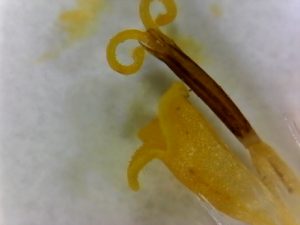
    44 disc flowers of 5 connate petals

    44 carpels
    # stamens? I think there are 4 in each disc flower, so 176?

    I wasn’t able to determine placentation.

  • ELMValentine – Fireweed Dissection

    As I wrap up each of my four plant dissections, I’ll post them indivudally to the class website.  These dissections were fun to do, and a good challenge to use the new terms we used in class.


    My first dissection was of fireweed (Chamerion angustifolium  (L.) Holub.  This was the first fireweed that I’ve seen in bloom this year.  Knowing there are many more to come, I was OK with harvesting it to dissect for class.


  • Nuphar lutea dissection

    Because I fractured my wrist on June 7, I picked a rather large flower to dissect one handed: the yellow pond lily.

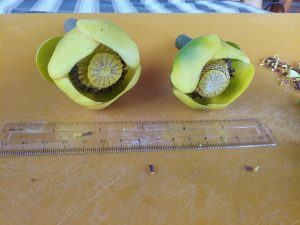
    It was an interesting plant.    The sepals are in two rows.   On each solitary flower, the outer row has 2 small, tough, thick, and leathery green sepals, and the inner row has 2 larger, soft yellow-green ones.   They remind me of an artichoke.   The five petals within are the same shape but, yellower and frailer.   The burgundy-brown stamens, tipped with yellow anthers that curve inward are VERY numerous, arranged tightly in eight rings around the ovary.   The 15 styles seem to be fused to the top of the superior ovary, at least at this time of year in a symmetrical pattern.   It looks very decorative, like a clock face or pin cushion.   The ovary is ribbed beneath each style line. The interior of the ovary is densely packed with eggs between the ribbed carpels.   Since the eggs are the same greenish whitish color as the walls of the numerous vertical carpels, so they are difficult to distinguish in my photos.   I read that the ovary explodes to release the starchy seeds.   I detected no pollen dust, but did see lots of flies on each specimen.   Another interesting factoid I learned is that pond lilies emit alcohol rather than carbon dioxide.   This attracts the flies rather than other pollinators. The green, heart shaped leaves are large (7-11 inches) and rather leathery, with pronounced parallel ribbing on the dorsal side, like a banana leaf.   The habitat is a shallow lake, within about 20 feet of shore.   See photos below.   I enjoyed this assignment and look forward to wielding the dissection tools on smaller specimens when I have use of both hands again.

  • Plant Dissections

    I thought this assignment was pretty fun, except for the fact that after I had completed 3 of my dissections my phone, with all my pictures, gave out on me. Luckily I had quite a bit of down time while I was in Point Lay and was able to the lens attachment with my iPad to do them all over again. Point Lay is a little warmer than Barrow, but still along the coast of the Arctic Ocean. The flora there was just starting to bloom, so it really worked out for me. Instead of creating individual pictures, I put all of my dissections into a power point presentation. I thought it was pretty neat to look closer to the flowers and really understand how different they are. Each of the flowers I dissected were so very different from the next!

    Plant Dissections


  • Day lily dissection

    Family: Asphodeaceae/Hemerocalidoides
    Hemerocallis lilioasphodelus L. (Buttered Popcorn)

    6 Petals 4-5 cm L X 2 cm W

    6 stamen: 4-5 cm L

    Pistil- 5-6 cm L

    Pedicels: 1-1.5 cm

    Throat of calyx/corolla: 2.5 cm

    Bracts at each node.

    Pistil divided into a cross-section and longitudinal section, showing the receptacle.


    Final dissection showing the petals, stamen, pistil, throat and bracts.

  • Yucca glauca dissection

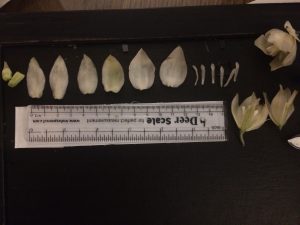
    Yucca glauca in it’s “natural” habitat. Although this particular plant seems to have been planted as an ornamental outside of a community garden. Where I grew up in Western Nebraska, they grow everywhere! When we would drive the cattle up for summer grazing, the cattle always loved to strip the flowers off of the stalk and it would be hard to move them because they would stop every 20-30 feet.

    Yucca glauca Nutt.

    Family: Asperagaceae

    Subfamily: Agave

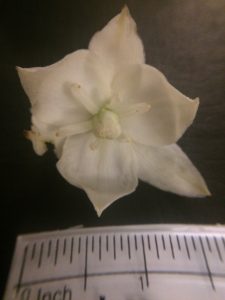
    Leaves form in basal rosettes with long, narrow pointy leaves that are between 40 and 60 cm long and 1-2 cm across. They have an erect central flower stalk and an inflorescence that is 80-100 cm tall with lily-like pendent flowers that droop off of 3-4 cm pedicels. The flowers are white to pale green.

    The flower has 3 sepals and 3 petals (tepals?). The sepals are the same color but only 1.5 cm in width compared to the petals being 2 cm wide.


    6 stamen that are covered in a fuzzy hairs

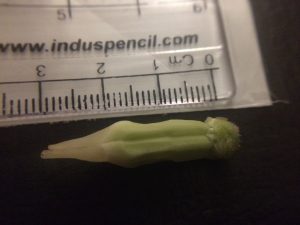
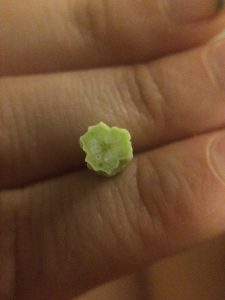
    3 fused carpels that are encased in a capsule (3 cm long)

    A cross-section as well as longitudinal section of the pistil

    The final dissection!