Attached are my images and description of my plant dissection of Heracleum maximum.
Category: Dissections
-
Plant Dissections
I wanted to get this published before I head down from Anchorage to Hope to camp for the night. I am looking forward to checking out the wildflowers on the way. I worked a lot this week, so two of the plants were from my work, one from indoors and one from the parking lot. I wish I had more time to dissect and label with more detail. I had a lot of fun using the macro lens. I found that the lighting was difficult for me and I tried to use white paper to reflect as well as an additional desk lamp.
-
Dissection (4 of 4)
Cornus Canadensis (Canadian Bunchberry)
Family: Cornaceae
Habitat:

Leaves:


Overview (6 whorled leaves):

Flowers:


Petals:

Center of flower (within are individual flowers with pedicels, pistils, and stamens):

Pistils:


Stamens from a single pistil:

-
Dissection (3 of 4)
Rubus idaeus (European Red Raspberry)
Family: Rosaceae
Habitat:

Leaves:


Flower (5 petals)


Stamens:

Carpels:


-
Dissection (2 of 4)
Pyrola Asarifolia (Bog Wintergreen)
Habitat:

Inflorescence/flowers (as you can see there are not a lot of leaves except for the small attachment at the base of the pedicel) :


Petals (note adnation of stamens fused with petals) :


Sepals:


Stamens:

Carpel:

Pistil:

Ovary:


-
Dissections
It’s something of a mess but these are my dissections of four different flowers found at UAF’s campus. The fours dissections are of Ox-Eyed Daisies (Chrysanthemum leucanthemum), Bleeding Heart Flowers (Lamprocapnos spectabilis), Lilacs (Syringa pubescens), and a white flower from a shurb outside of Moore Hall at UAF I couldn’t identify.
-
ELMValentine – Tall bluebells dissection
The final plant I chose for my dissection was the tall bluebell (Mertensia paniculata (Aiton) G. Don)). Thanks for the great class. I look foward to reviewing everyone else’s dissections in the coming days!


-
ELMValentine – Spreading dogbane dissection
The third plant I dissected for this assignment was spreading dogbane (Apocynum androsaemifolium L.). I found a lot of these growing on the hill below our house.


-
plant dissections
Here are my plant dissections: wild rose, yarrow, lilac, and wild mustard
-
Fragaria Dissection (#4 Emerson)

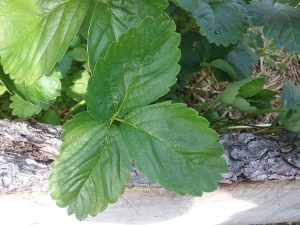
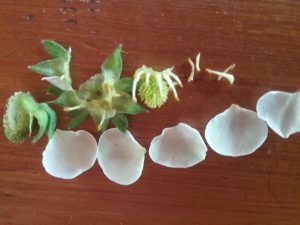


 I have been delighted that Sitka strawberries have naturalized in my front yard as a pretty and fast expanding ground cover. To give the fruits more sun, I harvest leaves that I dry for a mild and slightly tannic addition to tea mixtures.
According to my readings, the various wild and domesticated varieties vary in the number of petals. The ones I photographed (not Sitka, which flower later) have five, broadly ovate petals – white with a tinge of yellow at the point of attachment. Sources assert five sepals as well, but I count ten. On the other hand, they are so tightly fused to the base that I tore them when looking, but it certainly looks like five thin and five wide to me. All attach at the bottom of the receptacle (the future fruit), along with a circle of stamens. I counted 18 on my best specimen. The receptacle is yellow green at this time of year, and firm, covered with numerous short, yellow pistils which will form achenes in the mature fruit.
The compound leaves (three leaflets) are dark green, serrated, slightly hairy and stiff, with deep, parallel venation.