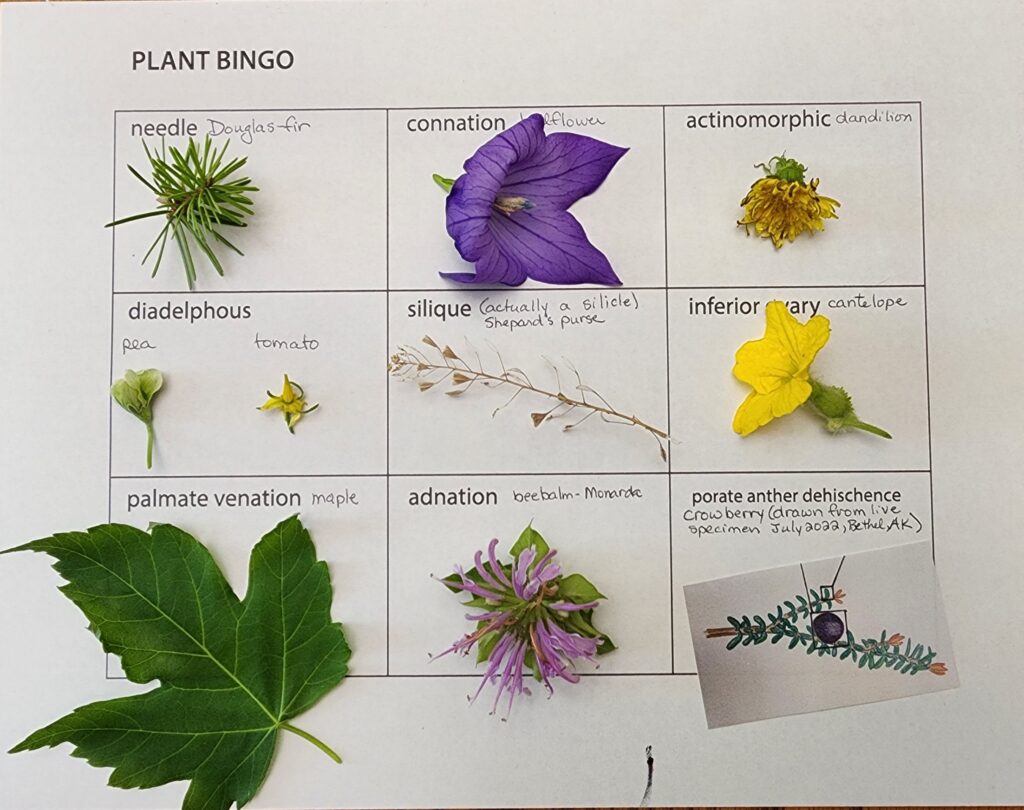
Plant Bingo 2023

Written by

in

I tried to find a live specimen for the “porate anther dehiscence”. I had just planted an American wintergreen, which is in the Ericaceae family, but the squirrels had eaten all the berries! I decided to use my drawing of crowberry that I drew for EBOT 100 last summer. There are not a lot of the Ericaceae family in my area, so that was the best I could do.

Comments

4 responses to “Plant Bingo 2023”

  1. Stefanie Ickert Avatar

    Thanks Denise,
    this is great! Yes, you also can replace one of the terms with a term you would like to feature with an image, so these all work well. The porate anther dehiscence is always a bit tricky, especially if you are not in Alaska. Here is a recent example from a dissection of Vaccinium uligonosum with porate anther dehiscence and anther appendages.

  2. Denise Wally Avatar
    Denise Wally

    That is really interesting. I don’t even remember learning about that in botany during my undergrad (so, so long ago). I want to find plants that have that feature, here. We don’t have too many Ericaceae species here, but we have a few. I’ll be on the hunt for them!

  3. Emily Becker Avatar
    Emily Becker

    Hi Denise. This is awesome and so helpful. Can you explain why the bee balm shows adnation? I need some more examples, please and thank you!

  4. Stefanie Ickert Avatar

    The mint family (Lamiaceae) generally has stamens adnate to the corolla. Here is a dissection of Hanceola suffruticosa Y.P. Chen, A.J. Paton & C.L. Xiang (Lamiaceae) flower from https://phytokeys.pensoft.net/article/49995/zoom/fig/12/ showing the stamens attached to the corolla, a good example of adnation.

Leave a Reply

Your email address will not be published. Required fields are marked *