

Needles: Douglas fir
connation: Strawberry
diadelphous: White Sweet clover
palmate venation: Thimbleberry
silique: Hedge Mustard
adnation: Orchid
actinomorphic: Hedge Bindweed
inferior ovary: Dandelion
porate anther dehiscence: Clover
Needles: Douglas fir
connation: Strawberry
diadelphous: White Sweet clover
palmate venation: Thimbleberry
silique: Hedge Mustard
adnation: Orchid
actinomorphic: Hedge Bindweed
inferior ovary: Dandelion
porate anther dehiscence: Clover

A few notes on the bingo card:
Hopefully this picture is clear enough to see the rest!
1a. Leaves are needle-like. . . . . . . . . . Plant 1
1b. Leaves are broad
2a. Flowers are predominantly purple. . . . . . . Plant 3
2b. Flowers are white or yellow
3a. Leaves are compound. . . . . . . . . . . . Plant 2
3b. Leaves are simple. . . . . . . . . . . . . . Plant 4
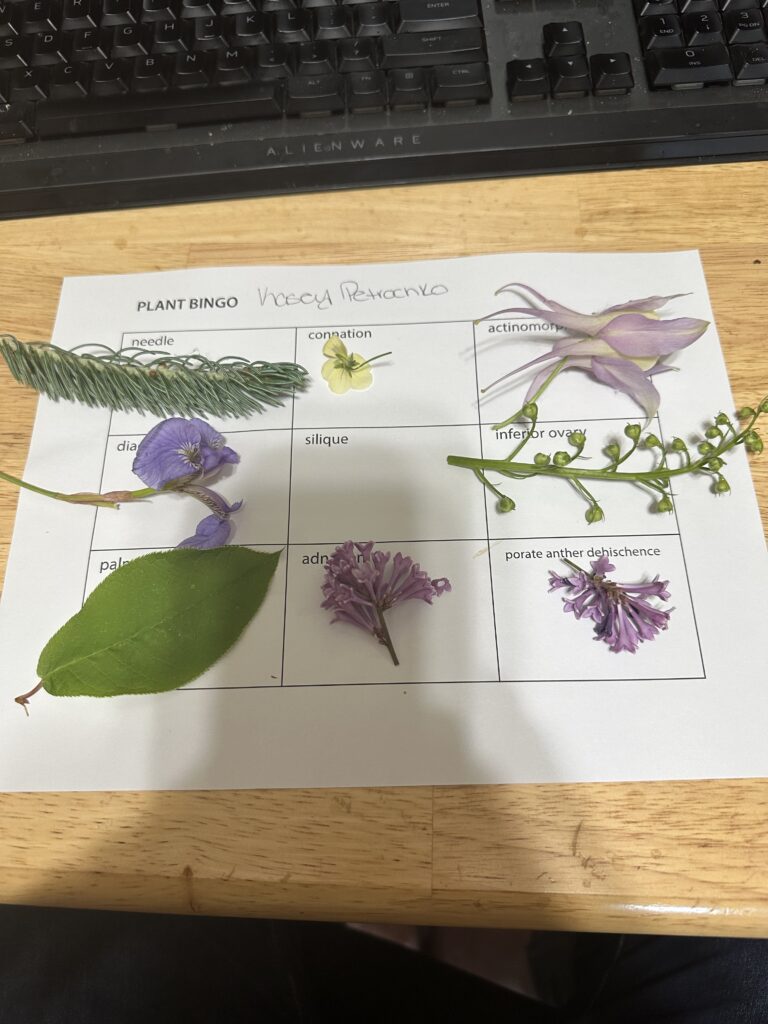
I was, unfortunately, unable to find any qualifying plants for the “silique” category. I retrieved these plants from my front yard.

Needle: Picea glauca; connation: Rhododendron menziesii; actinomorphic: Geranium (pratense?); monadelphous: Lupinus spp.; silique: Brassica (rapa?); inferior ovary: Rosa spp.; palmate venation: Oplopanax horridus; adnation: Fritillaria (camschatcensis?); porate anther dehiscence: Moneses uniflora
This was a fun, but surprisingly challenging assignment. I had trouble with finding specimens that fit into the diadelphous (which I was permitted to switch to monadelphous), silique, and adnation categories. For silique, I was unable to find any brassicas in my area, so I used a picture I took of some field mustard last year. Unfortunately, the siliques are not very visible, but hopefully it still applies. I don’t have a microscope, so to demonstrate the porate anther dehiscence, I zoomed in as much as possible with my camera.
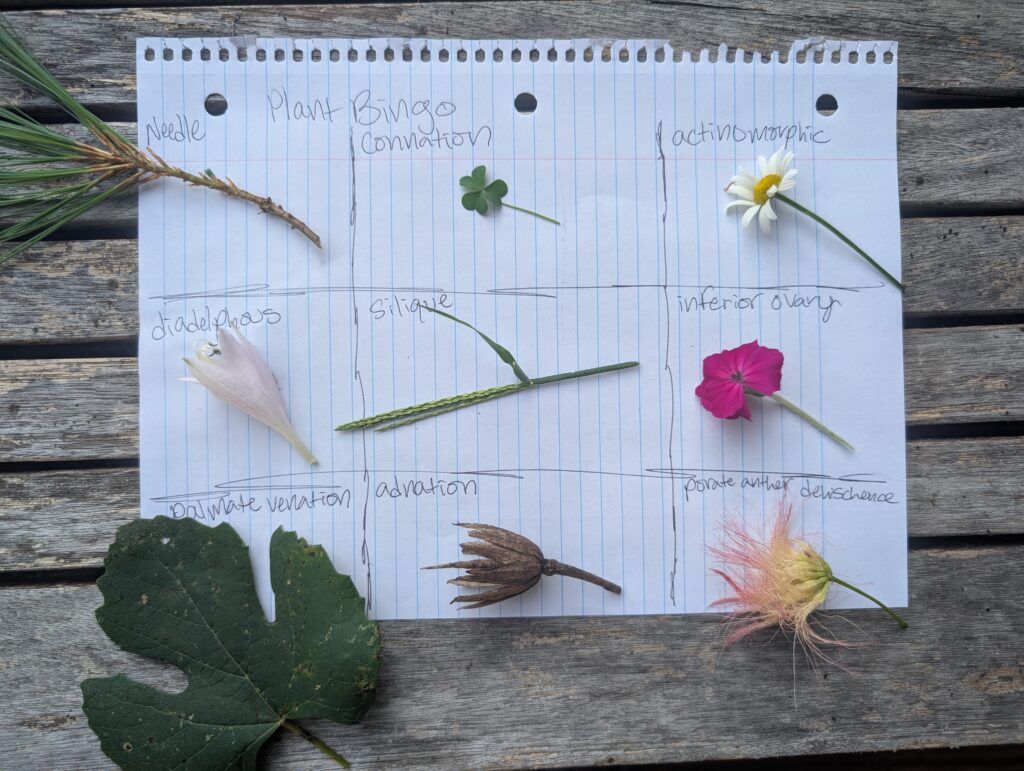
I was unable to find plants for every single category as there are not a lot of flowers in my area currently. I did my best!
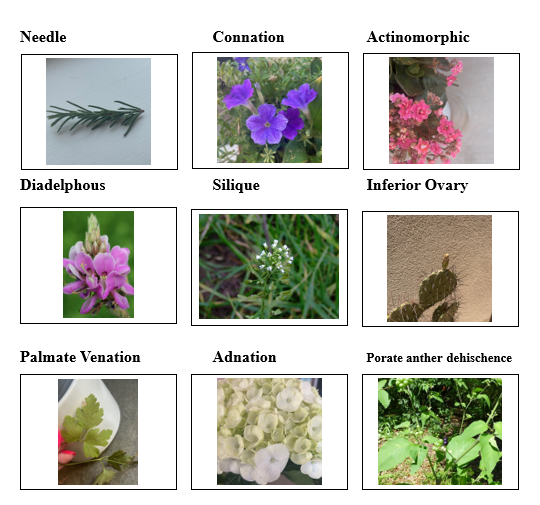
While this activity was fun, it was a bit difficult. A few of my plants I was unable to find in my location, which resulted in me having to use resources online.
Dichotomous Key
A. Plant that produce cones………………………………………………….. Plant 1
A’. Plant does not produce cones………………………………………….. B
B. Flowering plant without petals………………………..… Plant 4
B’. Flowering plant with petals ……………………………… C
C. Flowering plant with purple petals……. Plant 3
C’. Flowering plant with white petals…….. Plant 2

