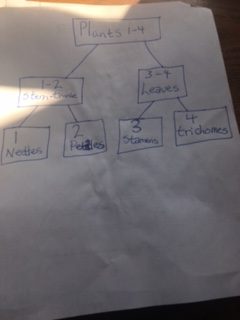
A. Flowering Plants
B. White Petals – Plant 2
B. Violet Petals – Plant 3
C. Flowering plant without petals – Plant 4
A. Non-Flowering Plant – Plant 1 (tree with needles)
A. Flowering Plants
B. White Petals – Plant 2
B. Violet Petals – Plant 3
C. Flowering plant without petals – Plant 4
A. Non-Flowering Plant – Plant 1 (tree with needles)
Dichotomous Key Updated*
For this assignment, I read your dichotomous key, Prof. Ickert-Bond’s response, and then used your key to identify the plant examples provided. You determined a lot more attributes and definitions than I did in the process of creating our keys. Good work! Your formatting is neat. I relearned “whorl” through your post. One term that I encountered that might work here, strigose indicates the existence of hairs. Glabrous/ puberulent describe hairless plant parts.
My only criticism would be the either/or aspect of the dichotomous key. The statement you make to categorize your plants should only have 2 options. It helped me to think about coming across a path with 2 options, the eye doctor choosing between lenses, or the choose your own adventure stories from my childhood. Anyways, I combined out Dichotomous Keys to create a much better key. Thanks!
Dichotomous Key
(A’) Plants without Green Coniferous Needles
(B) Plants with strigose hairy leaves
(C) Petals purple ………………………………………. Plant three
(C’) Petals white ………………………………………. Plant two
(B’) Plants without strigose hairy leaves, glabrous/puberulent ………… Plant four
Dichotomous Key
(A) Plant with needles
(B)Pinecone present – plant #1
(A’). Plant without needles
(C). Plant with teeny tiny flowers, packed closely together
(D). Flower color: yellow – plant #4
(C’). Plant with flowers, not packed closely
(E). Petal color purple – plant #3
(E’). Petal color white – plant #2
Creating this key was harder than I thought it would be since I had to resist the urge to make it more complex than it really was. Also, I really wanted to try to describe the leaves but there were not enough (or too many?) dichotomies that I could see from the images.
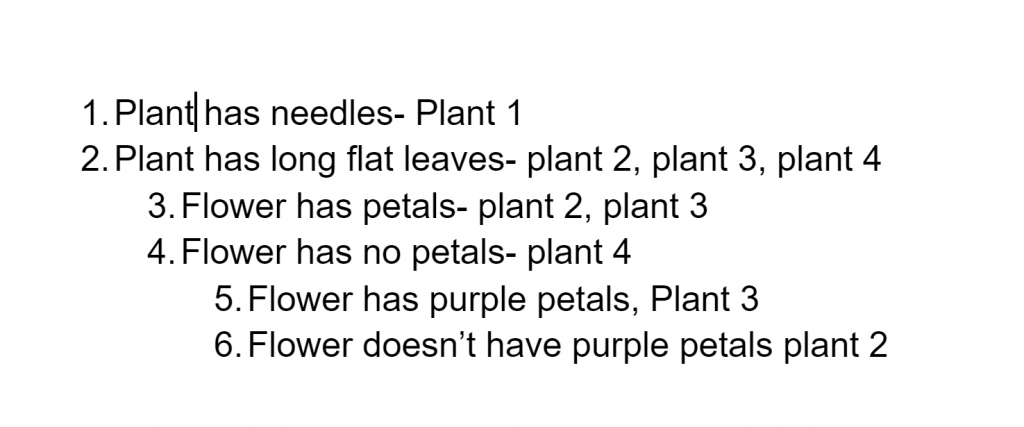
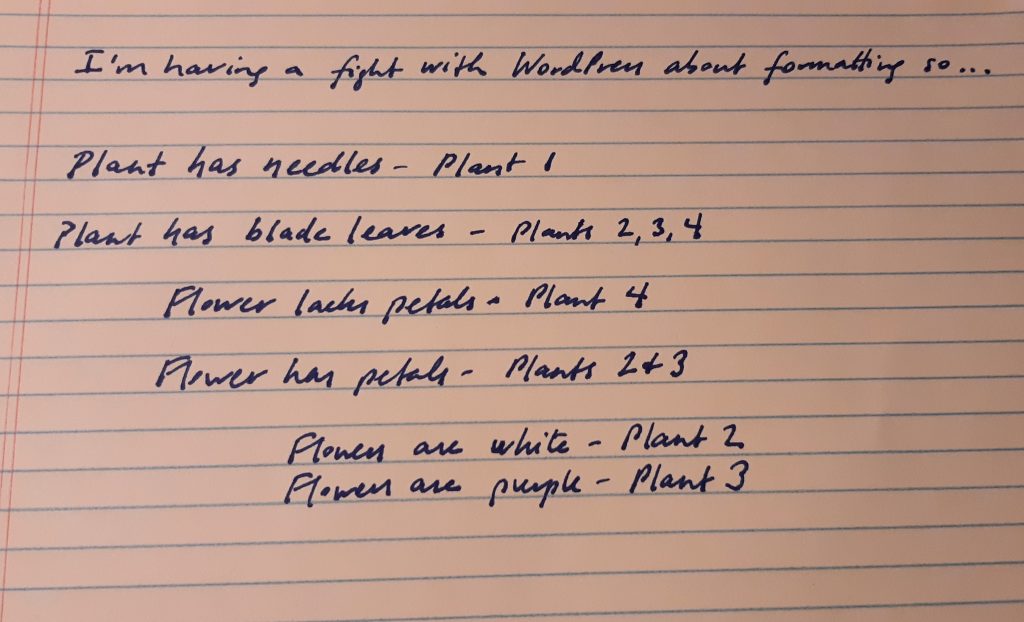
A. Plant has needle-like leaves – Plant 1
A. Plant has flat or diverse leaves – Plants 2, 3 & 4
– B. Flowers monoecious – Plant 4
– B. Flowers bisexual – Plants 2 & 3
– – C. Petals white – Plant 2
– – C. Petals purple – Plant 3
I sure do hope that there are multiple correct answers for this exercise – fun!
I’m guessing that the purple flower is Pulsatilla patens L. ?
I didn’t know how to describe the leaf so I decided to dissect Hultén’s description to help me understand what to look for.
This is what Hultén say about Pulsatilla patens L. followed by the botanical terms defined.
“Silky-villous; silky-bearing long soft (not interwoven) hairs
stems from vertical, dark-brown, many headed caudex; woody, perennial base of an otherwise herbaceous stem
basal leaves developing after floration, ternately divided into three segments, the divisions 2- or 3- partner into numerous narrow segments;
the very villous involucrum whorl of bracts subtending a flower cluster, deeply cleft into narrow, lanceolate, acute lobes;
sepals blue or purple;
staminodia sterile stamens, or any other structure without anther corresponding to a stamen gland like;
fruit plumose having fine hairs on each side; feathery when ripe.”
~Hultén, Flora of Alaska p. 466
There is no mention of petals in the description above that I can see – why is that?
Dichotomous Key Identification Exercise:
I would like confirmation that the Purple violet in the images is V. nephrophylla and that the White violet is V. renifolia var. brainerdii.
I feel pretty confident that the Spruces shown are 1. Picea glauca and 2. Picea mariana.
A: Does it have needles.
Yes, plant 1
No, B
B: Does it have flowers.
Yes, C
No, plant 4
C: does it have purple flowers
Yes, plant 3
No, plant 2
Dichotomous Key for Picea (Spruces) – Plant 1 Image
Dichotomous Key for Plant Images
A. Is a tree
1A- Needles straight, 2.5cm long (longer needles), sharp, four-angled, and roll between the fingers ………….. White Spruce (Picea glauca) Plant 1
B. Is a flower
1A – A slim, cylindrical flower cluster, with inconspicuous or no petals, hair on leaves, over 20 stamens ………………. Plant 4 (Catkin)
2. Has petals
2A – has four drooping petals, hair on the stem ……………….. (Plant 2)
2B – has six petals, purples, over 10 stamens …………… (Plant 6)