Category: Dichotomous Keys
-
Dichotomous key
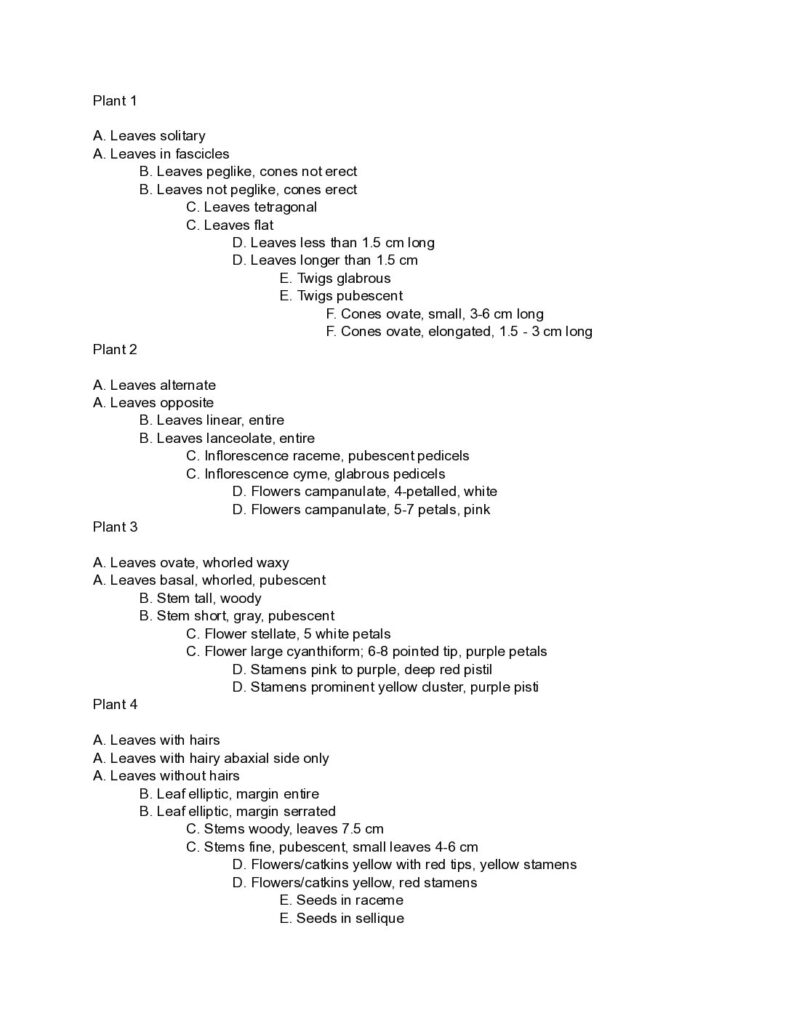
A.Plant One:
B. Needles with flat cross section–slightly rounded at the tip, green in colour–some brown spots.
B1. Branchlets glabrous; cones.
B2. Thick, cylindrical bole (trunk)–aereal stem of plant.
B3. Perennial plant.
A. Plant Two:
C. Flower white in colour.
C1. Rootstock stout; drooping.
C2. Compound plants.
C3. Nodes and internodes.
C4. It has 4 petals.
C5. Raceme.
C6. Flowers sit on pedicels (a pedicel is hairy-looking–pedicel trichomes).
C7. Sepals, stamens-interior (tetradynamous stamens).
C8. Stamens with yellow pollen on tips.
C9. Whorled.
A. Plant Three:
D. Flower violet in colour, white at the base.
D1. Drooping rootstock stout.
D2. Plentiful amount of stamens interior to petals.
D3. Stamens yellow in colour–there appears to be 4.
D4. Several nodes on the stem.
D5. Pedicel trichomes.
A. Plant Four:
E. Ericaceae.
E1. Leather-like leaf.
E2. Outgrowing stamens exposed–yellow and green in colour and red in colour at the base bud of stamens
F. Dissected flower with 2 stamens per bud.
F1. Dissected flower with 3 stamens per bud.
F2. Dissected flower with 4 stamens per bud.
E3. 22mm length of the entire bud.
E4. Pedicel trichomes.
E5. Dissected–between 2-4 stamens per bud.
-
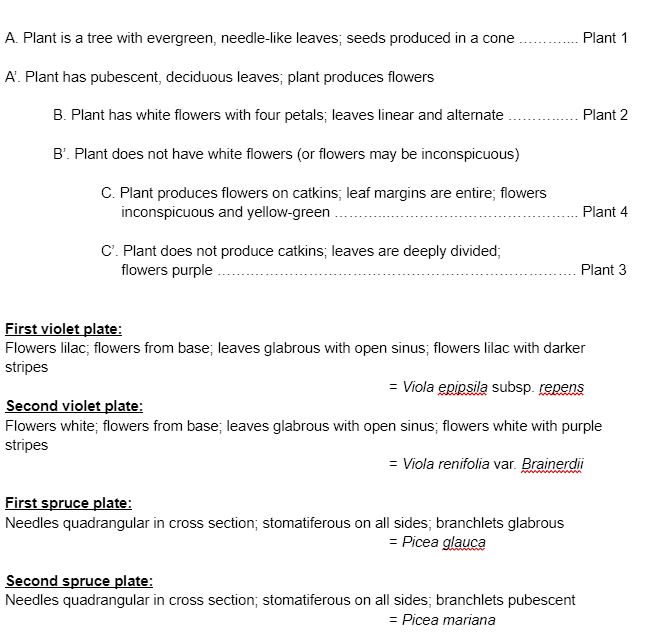
Dichotomous Key Practice
A. Plant is a conifer …… Plant 1
B. Plant is Herbaceous
- Leaves are pubescent and elliptic…..Plant 4
2. Leaves are pubescent and linear
a. flowers are white….Plant 2
b. flowers are purple….Plant 3
-
Dichotomous Key for 4 plants
A. Woody – B
A-1. Herbaceous – C
B. Plant has needles – Plant #1
B-1. Plant does not have needles –
C. Simple leaf – D
C-1. Compound leaf –
D. White petaled flowers – Plant #2
D-1. Violet petaled flowers – Plant #3
D-2. Yellow catkin – Plant #4 -
Dichotomous Key
1a: Plant with cones……. Plant 1
1b: Plant without cones
2a Leaves lanceolate or narrow and pubescent
3a Leaves gathered near top of stem ….. Plant 3
3b Leaves more numerous near base of stem …. Plant 2
2b Leaves ovate and pubescent …. Plant 4
-
Dichotomous Key
A. Plants with Needles…Plant 1
A.1 Plants with leaves…B
B. Plants with complete flower…C
B.1 Plants with pistillate and staminate flowers…Plant 4
C. Petals are white…Plant 2
C.1 Petals are purple…Plant 3
Plant One: Plant Two
Plant Three: Plant Four:
-
Dichotomous Key
A. Has flowers – B
A’. No flowers – C
B. White flowers – Plant 2
B’. Purple flowers – Plant 3
C. Monodelphous – Plant 4
C’. No Stamens – Plant 1
This dichotomous key is not applicable in other settings. -
dichotomous key
A. Plant has needles —— plant 1
A’. Plant does not have needles —— B
B. Leaves are oblong in shape —— plant 4
B’. Leaves are lance-shaped ——- C
C. Flower petals are white —- plant 2
C’. Flower petals are purple —- plant 3